
Ah, description. I have quite a lot of thoughts on it,and generally I think I still struggle with it, but my insight was requested, so here it is.
I've always felt that I'm quite austere with description, and only occaisionally punctuate it with more poetic flourishes. Generally I don't go looking for an image if I don't have one, but if an image comes to mind as I'm writing I aim to incorporate it, and will sometimes reshape a scene with it in mind.
I try never to do a full paragraph of pure description, or if I must I try and add a bit of immaterial incidental activity or some thematic element to make it more dynamic; even something as simple as following a raindrop as it breaks over the stone parapet of a castle and trickles down the sandstone, is cast briefly back into freefall as it passes the window of the young lord's nursery, traces the contour of a gargoyle and finally joins the muddy slough of the courtyard, where it's abruptly spattered by the boot of the smith's apprentice, our POV character for the chapter. (And as an aside, I made that up on the spot as an example. I'm aware it's bollocks and contrived.)
I never ever give a full description of a character when he or she first appears in the narrative. This to me always recalls the days of primary school creative writing lessons, and a full biometric run down of leg measurements, bust size and eye colour according to the handy Dulux reference sheet bespeaks to me preteen dabbling in storytelling like nothing else. Instead, I go for just a couple of words to give the reader a sketch, then a few more hints and mentions throughout that scene when they fit to flesh things out. By the end of the first scene the reader should have a good portrait in their mind's eye of what the character looks like, but not enough to construct a Crimebusters photofit. Later, I'll generally only add further embellishment if it flows naturally, usually in the form of callouts to particular features where that feature is the focal point of a particular gesture or act.
Location setting is more needy, and usually I do open up with multiple lines of description, but I'll almost always try to go for incidental action or thematics to enliven it. For example in Red Flag, the opening description of Darken's fortress takes in its appearance, its local, and its atmosphere, but does so with a distinct emphasis on the imposing, impenetrable fortress-qualities of the place. Then the action kicks off with Hel immediately puncturing these defenses, making the description feel more like a set up for this pay off - which in turn describes to us some facet of Hel without saying anything - and less like a simple verbal painting in of the stage.
For me the hardest description is in pronouns and adverbs. The technical stuff. You know you don't want to keep doing 'He said, she said, he did, she did' but this stuff is very hard to give flow and character without being gruesomely overstated and flowery. In truth almost all dialogue does have to be a 'he said' job, but when things are clicking just right I'll spot without thinking the opportunities for a 'whispered' or a 'hissed' or maybe a 'said with a thin smile' or something. One of those will colour a lot of conversation; like a dye only a drop is needed.
Another skill I'm trying to grasp is the art of description, narrative digression and action amid dialogue. A lot of my stories are really minimal two-hander playscripts with the stage directions rewritten as narrative. I need to work better at realising the potential in prose.
Related to that is long-form sections of speechless action. I'm a speaky writer, no doubt about that, and I sometimes find myself grasping when I need to convey a couple of thousand words with negligible discussion (though I do find myself to have a knack for actual action scenes). I've had to actively study how this is done in 'real' books and again it's almost always about narrative digression. You segue into more conceptual or thematic or conversational prose for a bit as you coast along the action, drawing jumping off points from the events you detail whilst angling your theme to flow in the same direction as the story is heading. It's a good skill, the skill I'm most keen to hone. Narrative voice is where it's at. I generally pinpoint my main struggle with the actual words these days at not having a fully formed voice, and so having to actively work at each line. I can't simply start to 'talk' in narrative on the page. This is why I often favour first-person narration. I'm much better at naturalistic character dialogue and can rapidly assume an in-character narrator. I've also tried to muddy the water with characterful third person narration, but that's tricky and will often come out annoying. It's generally best suited to humour but doesn't have to be. Funnily enough when I was a writing machine back in my teens and stuff would just flow for me, I felt - and I still do feel - that my narrative voice was keenly honed. I had no plot in those days, so my writing was just meandering stylistics, and yet it flowed and had a certain attraction I still can't deny. Somehow over time I've completely lost that skill whilst picking up the (probably more needed) insight into plot mechanics. Characters I've always been good at, although I sometimes find it hard to kick the pebble down the mountain. My experiments in a shared universe have come so much more easily for me because AO'M had already set the shale scattering and all I had to do was jump on and surf down the quarry pit, pulling elaborate ollies and 360s of characterisation with my borrowed board.
...You see? That's what happens when an image hits me. Although it usually helps when it's less stupid.
Thursday, 12 May 2011

Tuesday, 12 April 2011
I Hope We'll Be Here When They're Through With Us
Realised finally why I am so resistant to getting an eye test. Have so little identity that I am clinging even to negative traits. ('That's Phil, his eyesight is shit.')
My most distant friends are the closest to me.
Recurring dreams are very rare, and occur only when I am truly obsessing over something.
Fantasy scenario is theoretically a possibility, but practical costs and likely ruinous. I keep circling it.
Have discovered a new identification figure.
I have incredible ideas every day. I am convinced of their brilliance. I can't execute on any of them.
Recently I've been reminded of all the things I wanted to pursue that were cut short. I had mostly forgotten about them until now.
I don't write about myself very often. Afraid of spiralling. Will probably stop now?
Why all of this? Because I wanted to write and was struggling.
My most distant friends are the closest to me.
Recurring dreams are very rare, and occur only when I am truly obsessing over something.
Fantasy scenario is theoretically a possibility, but practical costs and likely ruinous. I keep circling it.
Have discovered a new identification figure.
I have incredible ideas every day. I am convinced of their brilliance. I can't execute on any of them.
Recently I've been reminded of all the things I wanted to pursue that were cut short. I had mostly forgotten about them until now.
I don't write about myself very often. Afraid of spiralling. Will probably stop now?
Why all of this? Because I wanted to write and was struggling.
Monday, 28 March 2011
Tell the People: Vince Cable Advocates Direct Action
"No government - coalition, Labour or other - would change its fundamental economic policy simply in response to a demonstration of that kind."1So sayeth Vince Cable yesterday, with regards to the March for the Alternative that took place on Friday. I cannot imagine a greater vindication of direct action and civil disobedience than that. In a single sentence Cable has affirmed the facticity of a truth understood by all who believed in the rightfulness of direct action.
Let's be clear. Direct action is not an intensifier in the dialogue of protest. It does not exist to punctuate our statement by saying, 'Yes, we are this angry.' Just and neccesary direct action must be both of those things. They are mutually inclusive. Neccesary action is always just, and just action must always be neccesary. When the state condoned form of protest discourse has been sublimated by the system such that its power is negated (as it is in our current system, where it is diffused along socially prefigured lines of characterisation and storytelling, repackaged as an old, powerless narrative), then direct action becomes neccesary. This should not be hard to accept: When there is no power in civil obedience, we must turn to civil disobedience to become empowered. (And the rider to that, which is that we must not accept disempowerment.) All of those who have been acting upon the rightfulness of direct action (and here I most definitely include UK Uncut, and exclude the stupidity of the Black Bloc) have held at heart the knowledge that civil obedient protest - marching and rallying - has been disempowered. Until now that view has had opposition from ineffectual neoliberals insisting that endless marching within state constraints is the only rightful form of protest.
As of yesterday, that argument has been exploded. No longer is this argument contested. Now we have a statement, a declaration from one of the central figures in the ConDem cabal, that the civil obedient form of protest will not be recognised by the state in any effectual way. It almost beggars belief that Cable would misstep so badly as to make a statement so blunt, but so he did, and the ConDem mask has slipped. The government will not listen to its people. We must disobey to maintain common power, and we must not surrender common power. There's only one course of action.
Now we need to get that message out there. It saddens me that so few people will even see Cable's message, and fewer still will grasp what it means. We need to push it out, educate people. If people truly understood what was happening in this country's political sphere (and beyond it, of course) they would be frightened for the future. Anyone who is not concerned about the path we are taking, nor angry at the exercises of power by these falsely elected ideologues, does not understand what is happening. Or, of course, they're one of those who stand to profit. We need to make sure people do understand, so actions like this do not slip past barely noticed nor challenged:
'Academic fury over order to study the big society'
One line in particular stands out:
The Arts and Humanities Research Council (AHRC) will spend a "significant" amount of its funding on the prime minister's vision for the country, after a government "clarification" of the Haldane principle – a convention that for 90 years has protected the right of academics to decide where research funds should be spent.This use of the word 'clarification' is deeply, deeply sinister. It's an omen of things to come. What other policies and principles might the coalition see fit to 'clarify'? In the face of such things, when fully comprehended, who would not be up in arms? So it's vital we make sure these actions, this information, is diseminated and understood. Cable has given us a perfect rallying point, a statement simultaneously sweeping in its impact yet uncommonly clear in its meaning. Now we need to let people know.
Tuesday, 1 March 2011
Prime Cut
I have a proper update to post at some point. For now, though, my friends have started randomly getting thrilled over Halo, so it's time to redress the balance.
http://www.youtube.com/watch?v=aymXIIKwVDo&feature=fvsr
http://www.youtube.com/watch?v=aymXIIKwVDo&feature=fvsr
Monday, 10 January 2011

Sunday, 2 January 2011
Tiers Two: Judgment Day
A couple of top tier quickies - films whose inclusion are hardly groundbreaking.
Withnail and I
 This isn't even a remotely unusual choice, and so there is little I can say that isn't already known. In short, a story deeply tragic, yet uproarously hilarious, which maintains a constant texture to its dialogue, with not a line off target. Its true strength, though, is in the depth of its observation and reflection, which taps a much deeper vein of pathos than is usual of farce.
Indiana Jones and the Raiders of the Lost Ark
 Another craftsman's film, like Chinatown, and like others I've yet to list; films in which every aspect has been neatly crafted to mesh as an elegant, solidly constructed whole. In this case Lucas and Spielberg had their eye on cinema as a medium of entertainment, and they produce a piece with fun pouring from its truly cinematic workings. A beautiful score, superb setpieces (that have become film history), humour and adventure that rose straight out of a nostalgic awareness of the producers' own childhood joys.
Harrison Ford - almost skipped over - is a gift to the film, making Jones definitively his own. Much of the series' charm comes from its eponymous hero, because he's a hero for the underdog. Succesful and smooth at the right times, he's also at times acutely fallible, clumsy and oblivious in a sympathetic way unique among action heroes. In addition, that he is in his day job a professor and lecturer, who relies on knowledge and intelligence as much as he does his fists (nearly), he is far more a hero for the nerd generation that relishes in the films than the likes of Bruce Willis.
Withnail and I
 This isn't even a remotely unusual choice, and so there is little I can say that isn't already known. In short, a story deeply tragic, yet uproarously hilarious, which maintains a constant texture to its dialogue, with not a line off target. Its true strength, though, is in the depth of its observation and reflection, which taps a much deeper vein of pathos than is usual of farce.
Indiana Jones and the Raiders of the Lost Ark
 Another craftsman's film, like Chinatown, and like others I've yet to list; films in which every aspect has been neatly crafted to mesh as an elegant, solidly constructed whole. In this case Lucas and Spielberg had their eye on cinema as a medium of entertainment, and they produce a piece with fun pouring from its truly cinematic workings. A beautiful score, superb setpieces (that have become film history), humour and adventure that rose straight out of a nostalgic awareness of the producers' own childhood joys.
Harrison Ford - almost skipped over - is a gift to the film, making Jones definitively his own. Much of the series' charm comes from its eponymous hero, because he's a hero for the underdog. Succesful and smooth at the right times, he's also at times acutely fallible, clumsy and oblivious in a sympathetic way unique among action heroes. In addition, that he is in his day job a professor and lecturer, who relies on knowledge and intelligence as much as he does his fists (nearly), he is far more a hero for the nerd generation that relishes in the films than the likes of Bruce Willis.
Tuesday, 21 December 2010
Tiers of a Clown
So, in one of the many houses of reputable conversion I frequent, there came the discussion of films, and our personal 'best' canon. This led to me telling an interested participant that I would blog about my 'Top Ten' movies. But I don't have ten, so let's call it my 'Top Tier' movies instead. One thing that became apparent as I was running through titles in my mind is that there are a whole swathe of fantastic movies that sit JUST outside the boundary. I may only have 8 or so classics, but there's probably about 25 near-classics. On with the list!
Primer

This is a movie that will make you think. Like a cleverly structured puzzle box, it has many interlocking pieces that need turning over in your mind, sliding aside to free others. Shane Carruth pretty much came out of nowhere with his idea for a story about discovery and invention, and the people unprepared for it. He takes no prisoners, with extremely colloquial, naturalistic, elliptical dialogue, even when key plot information is disclosed. Nobody here is talking for the audience's benefit. And when combined with phenomenally natural performances - from guys who have never acted before - the effect is incredible. It is real in a way no other film captures. But it's challenging to keep up.
Add to that a plot where great swathes of cause and effect have ceased to exist, are never shown on screen, and have to be grasped through extrapolation, and you have a challenge. You cannot relax with Primer. You could not watch films of this kind all the time, without being a savant. But when you want something that will occupy every strand of your mind for hours longer than its running time, Primer is the film. As my brother said, it's a 4 hour film in 70 minutes.
It's not a cold, cerebral affair, though. Carruth came into the project to make a film about two guys, and their relationship. Their trust and friendship, and how it is affected by a paradigm shift in their reality. Again, no concessions are made to the audience. There's no soliloquys, no impassioned speeches writ large, no swelling orchestral score. But for all that, the subtle, understated emotion is truer, and more affecting.
It's also beautifully shot and produced, all by Carruth, who is apparently Leonardo Da Vinci reincarnate. I give it the highest recommendation, but only if you want a film you have to put effort into to get enjoyment back. And don't seek out plot information before you watch - It's not a twist ending film or anything of that kind, but it's about growing discovery and dawning realisation, and this atmosphere is perhaps hurt even more by spoilers than any shock twist would be.
Chinatown

Chinatown is pretty much a perfectly constructed movie. It's a plot movie, all about the story, but it perfectly crafts every aspect - visuals, sound, pace, performance - to tell that story in the most compelling way possible.
That story is a great one. A truly cinematic story, that gives itself over to powerhouse performances of its characters and striking visualisations of its bleak landscapes. It's a story about the brutality of those with power to those they hold power over - brutality more subtle and more destructive than physical violence - and an unanswered question about those who turn a blind eye, all symbolised by Gittes' old Chinatown beat that gives the film its name.
It is not, however, a relentless film. It's a film that finds warmth where it can in a cold and cruel world, and seizes it - and the warmth between Gittes and Mulwray triumphs over its context in a truly, ah, warming way. It has humour too, particularly in the wry observations and actions of Gittes himself.
Nicholson lives up to his reputation in the role of the PI who knows he should look the other way for his own sake, but can't beat his own good nature. I have seen neither the Shining or Cuckoo's Nest, but this, at least is a performance worthy of remembrance.
Faye Dunaway gives as good as she gets as Mulwray, and there is genuine energy in the scenes between her and Gittes. Their relationship goes through a vast sequence of twists and turns, and at every point the progression feels true and the place they are at resonates.
John Huston appears fleetingly, like Lecter in Silence of the Lambs, and also like that performance, he is vividly memorable and a dominant performance in just brief appearances. A compelling moral study, he is abhorrent, perhaps a monster, but one understands that he simply does not see the world the same way as we do. He is no monster in his own eyes. Huston provides a window onto understanding of that morality, and is intriguing for it.
I won't enumerate more cast members. There really is no dropped ball. The cast is as universally strong as the production. It's all about the story, and the story is superb, but the immense strength of every element behind it is what gives it such impact.
I have more movies to discuss, but I realised how long this was getting, so I'll do it in several installments. Be on the lookout for the next thrilling edition!
Primer
This is a movie that will make you think. Like a cleverly structured puzzle box, it has many interlocking pieces that need turning over in your mind, sliding aside to free others. Shane Carruth pretty much came out of nowhere with his idea for a story about discovery and invention, and the people unprepared for it. He takes no prisoners, with extremely colloquial, naturalistic, elliptical dialogue, even when key plot information is disclosed. Nobody here is talking for the audience's benefit. And when combined with phenomenally natural performances - from guys who have never acted before - the effect is incredible. It is real in a way no other film captures. But it's challenging to keep up.
Add to that a plot where great swathes of cause and effect have ceased to exist, are never shown on screen, and have to be grasped through extrapolation, and you have a challenge. You cannot relax with Primer. You could not watch films of this kind all the time, without being a savant. But when you want something that will occupy every strand of your mind for hours longer than its running time, Primer is the film. As my brother said, it's a 4 hour film in 70 minutes.
It's not a cold, cerebral affair, though. Carruth came into the project to make a film about two guys, and their relationship. Their trust and friendship, and how it is affected by a paradigm shift in their reality. Again, no concessions are made to the audience. There's no soliloquys, no impassioned speeches writ large, no swelling orchestral score. But for all that, the subtle, understated emotion is truer, and more affecting.
It's also beautifully shot and produced, all by Carruth, who is apparently Leonardo Da Vinci reincarnate. I give it the highest recommendation, but only if you want a film you have to put effort into to get enjoyment back. And don't seek out plot information before you watch - It's not a twist ending film or anything of that kind, but it's about growing discovery and dawning realisation, and this atmosphere is perhaps hurt even more by spoilers than any shock twist would be.
Chinatown
Chinatown is pretty much a perfectly constructed movie. It's a plot movie, all about the story, but it perfectly crafts every aspect - visuals, sound, pace, performance - to tell that story in the most compelling way possible.
That story is a great one. A truly cinematic story, that gives itself over to powerhouse performances of its characters and striking visualisations of its bleak landscapes. It's a story about the brutality of those with power to those they hold power over - brutality more subtle and more destructive than physical violence - and an unanswered question about those who turn a blind eye, all symbolised by Gittes' old Chinatown beat that gives the film its name.
It is not, however, a relentless film. It's a film that finds warmth where it can in a cold and cruel world, and seizes it - and the warmth between Gittes and Mulwray triumphs over its context in a truly, ah, warming way. It has humour too, particularly in the wry observations and actions of Gittes himself.
Nicholson lives up to his reputation in the role of the PI who knows he should look the other way for his own sake, but can't beat his own good nature. I have seen neither the Shining or Cuckoo's Nest, but this, at least is a performance worthy of remembrance.
Faye Dunaway gives as good as she gets as Mulwray, and there is genuine energy in the scenes between her and Gittes. Their relationship goes through a vast sequence of twists and turns, and at every point the progression feels true and the place they are at resonates.
John Huston appears fleetingly, like Lecter in Silence of the Lambs, and also like that performance, he is vividly memorable and a dominant performance in just brief appearances. A compelling moral study, he is abhorrent, perhaps a monster, but one understands that he simply does not see the world the same way as we do. He is no monster in his own eyes. Huston provides a window onto understanding of that morality, and is intriguing for it.
I won't enumerate more cast members. There really is no dropped ball. The cast is as universally strong as the production. It's all about the story, and the story is superb, but the immense strength of every element behind it is what gives it such impact.
I have more movies to discuss, but I realised how long this was getting, so I'll do it in several installments. Be on the lookout for the next thrilling edition!
Saturday, 18 December 2010
Supernatural Selection
After a friend shoved the discs into my hand with an injunction to watch them, and the reassurances of another that it was worth my time, I finally decided to overcome my skittish wussiness and watch Supernatural. It was good.
That's where my write up would end if Season One was all that existed. It's good. It blends folklore, classic rock and pop humour. But it's not exactly stratospheric. The cast all seem to be in their early twenties and it comes off a bit 'teen'. But, seeing as I had the DVDs in hand, and not much else to do, I went on to Season Two. It was better.
By the end of S2 the 'teen' feeling is gone, with a much wider, more interesting range of characters. The true plot has kicked in and events are clipping along with much more interest. Individual episodes have clever hooks, the humour is funnier, the music rockier, it's all notched up. Except the folklore, which takes a backseat to recurring demons and shapeshifters. That's the only disappointment. I went on to Season Three. It was excellent.
Somewhere around the beginning of S3 the show recieved an infusion of intense creativity. If an episode isn't advancing the central mysteries of the season, it's taking time out to explore superb, often hilarious concepts - many inspired by digging once again into the richness of foklore. The special 'A Very Supernatural Christmas', for example, sees the boys on the trail of what they suspect to be the Krampus, only to find out they've actually been tracking the Pagan Gods of Winter Solstice. The end of S3 was too good to break, and I immediately started S4. It was EVEN BETTER. The long game plot starts to come into focus, and it is good. The concept episodes are even more imaginative. The supporting cast is excellent. I finished it in three days. Now for season 5...
That's where my write up would end if Season One was all that existed. It's good. It blends folklore, classic rock and pop humour. But it's not exactly stratospheric. The cast all seem to be in their early twenties and it comes off a bit 'teen'. But, seeing as I had the DVDs in hand, and not much else to do, I went on to Season Two. It was better.
By the end of S2 the 'teen' feeling is gone, with a much wider, more interesting range of characters. The true plot has kicked in and events are clipping along with much more interest. Individual episodes have clever hooks, the humour is funnier, the music rockier, it's all notched up. Except the folklore, which takes a backseat to recurring demons and shapeshifters. That's the only disappointment. I went on to Season Three. It was excellent.
Somewhere around the beginning of S3 the show recieved an infusion of intense creativity. If an episode isn't advancing the central mysteries of the season, it's taking time out to explore superb, often hilarious concepts - many inspired by digging once again into the richness of foklore. The special 'A Very Supernatural Christmas', for example, sees the boys on the trail of what they suspect to be the Krampus, only to find out they've actually been tracking the Pagan Gods of Winter Solstice. The end of S3 was too good to break, and I immediately started S4. It was EVEN BETTER. The long game plot starts to come into focus, and it is good. The concept episodes are even more imaginative. The supporting cast is excellent. I finished it in three days. Now for season 5...

Saturday, 20 November 2010
Natural Selection
Torment must surely now give Bioshock, the Void and Braid a run for their money as the best game I played this year. This is what computer roleplaying games should always have been, and yet what they never have. It stands alone as a true roleplaying experience. You control who you are, and who you are really matters, because Torment is also packing a hell of a story. A richly thematic story about identity.
You wake up with no memory, and a few scant clues to your past life, and you strike out to learn who you were, and how you came back from the dead. But your search for your past presents dilemmas, and how you solve them says much about you, and a new question starts to become apparent. Who you were matters, but perhaps what matters more is who you are now. And if those two people aren't the same, well, doesn't that beg another question?
Opportunities to carve out your identity present themselves at every turn; the game is rich with layers and paths you can take, and it's all richly presented. The writing in the game is among the best in the genre - perhaps THE best. Certain dialogue scenes, not even voiced, are a greater thrill than any cutscene in Final Fantasy or Dragon Age. The story plays itself out with a perfectly measured pace, first unwinding mysteries steadily, letting the questions drawing you in one direction, then another, then beginning to drop revelations, twists, and turns - and some of the reveals are truly striking - before you emerge from a pivotal encounter with a goal in sight, and all of your answers - except for one, catalysed to seek out your destiny and show who you truly are once and for all.
The Planescape setting is one of the most vibrant and imaginative presented for D&D, and given license to make a game with it, it is to the boundless credit of Chris Avellone and his team that they sought to match its creativity, rather than carve and staid a traditional path through it. In a world where belief affects reality and creatures from an infinite number of worlds gather in the pub, Avellone and co capitalised fully on the richness of a universe prone to its own identity crises, and told the story of a man, and everything that could mean.
It's a nearly perfect game. It manages to transcend almost every flaw of the classic Infinity Engine system. Even the 1. 2. 3. dialogue boxes seem to fade from view under the strength of writing. It briefly stumbles when you take an excursion from Sigil, the central city, to some of the surrounding planes. In these places some of its fetch-quest, hack-n-slash roots briefly show, albeit still dressed in a phenomenally colourful trimming. This is the one and only time the game ever tired me, and otherwise I remained completely engrossed. I could, even now, go back and play through it again, and despite knowing its secrets from the start, despite having only just completed it, the opportunity to seek new answers to its questions would hold interest. I'll be sure that I do play it again a couple of years down the line, when memory has dimmed a little, and I'm sure I'll be transfixed a game.
This is what RPGs should be. This is what they never have been. A nearly perfect game. 9/10
Only one question remains...
You wake up with no memory, and a few scant clues to your past life, and you strike out to learn who you were, and how you came back from the dead. But your search for your past presents dilemmas, and how you solve them says much about you, and a new question starts to become apparent. Who you were matters, but perhaps what matters more is who you are now. And if those two people aren't the same, well, doesn't that beg another question?
Opportunities to carve out your identity present themselves at every turn; the game is rich with layers and paths you can take, and it's all richly presented. The writing in the game is among the best in the genre - perhaps THE best. Certain dialogue scenes, not even voiced, are a greater thrill than any cutscene in Final Fantasy or Dragon Age. The story plays itself out with a perfectly measured pace, first unwinding mysteries steadily, letting the questions drawing you in one direction, then another, then beginning to drop revelations, twists, and turns - and some of the reveals are truly striking - before you emerge from a pivotal encounter with a goal in sight, and all of your answers - except for one, catalysed to seek out your destiny and show who you truly are once and for all.
The Planescape setting is one of the most vibrant and imaginative presented for D&D, and given license to make a game with it, it is to the boundless credit of Chris Avellone and his team that they sought to match its creativity, rather than carve and staid a traditional path through it. In a world where belief affects reality and creatures from an infinite number of worlds gather in the pub, Avellone and co capitalised fully on the richness of a universe prone to its own identity crises, and told the story of a man, and everything that could mean.
It's a nearly perfect game. It manages to transcend almost every flaw of the classic Infinity Engine system. Even the 1. 2. 3. dialogue boxes seem to fade from view under the strength of writing. It briefly stumbles when you take an excursion from Sigil, the central city, to some of the surrounding planes. In these places some of its fetch-quest, hack-n-slash roots briefly show, albeit still dressed in a phenomenally colourful trimming. This is the one and only time the game ever tired me, and otherwise I remained completely engrossed. I could, even now, go back and play through it again, and despite knowing its secrets from the start, despite having only just completed it, the opportunity to seek new answers to its questions would hold interest. I'll be sure that I do play it again a couple of years down the line, when memory has dimmed a little, and I'm sure I'll be transfixed a game.
This is what RPGs should be. This is what they never have been. A nearly perfect game. 9/10
Only one question remains...
 What can change the nature of a man?
Saturday, 13 November 2010
If You Believe There's Nothing Up My Sleeve

Moon slipped by the popular consciousness rather quietly; I'm not even sure what it was released against, but it didn't make any big news. It got a few mumbles because director Duncan Jones is David Bowie's son, but these were mostly years ago, when it was first gathering momentum. As such it joins a pantheon of low-budget, high-concept, under-the-radar sci-fi movies that are really, really good.
Whilst not quite a one man show, Sam Rockwell is at the center of events, and the film's success rests on his shoulders. It must have been a treat of a part to get, providing some unique challenges, and Rockwell rises to them admirably, allowing one to become entirely embroiled in the conceit of the story. It's not always the most subtle of performances, but it's real and slightly, surprisingly, heroic. By the end Sam has not only our sympathy, but our cheers.
None of which is to dismiss Kevin Spacey, whose contribution is more understated, but wholly neccesary and pitch-perfect. In a manner which will remind the majority of HAL 9000, he imbues the robotic Gerty with just a hint of constrained emotion.
Gerty itself is a total coup on Jones' part. Whilst most will focus on Rockwell's character, there's is a great depth of interest in his mechanical companion. The design is ingenious: A chunky boom arm suspended from ceiling rails, with effector arms on seperate units, there is no semblance of humanoid silhouette at all. A tiny little LCD screen is the token attempt to create a human bond, displaying a smiling emoticon which briefly flashes other symbols when it wishes to express something. Whether Gerty is nothing more than a machine with a contrived display of humanity, or whether the strained companionship represents something human which is constrained by its medium, is an intriguing question.
Still, fascinating as it is, the question is essentially a sideshow, whilst the plot proper is concerned with Sam. There's not a great deal of story - it could be summed up in a paragraph - instead Jones is content simply to set up his concept and follow it as it unfolds, with events only falling into a more paced narrative toward the end. It's exploration and character examination, not SF thriller.
It's also pleasingly, if mildly, subversive. Halfway in, the film has a very familiar feel to it; it might almost seem like a pleasing blend of derivations, a variation on an old theme. But then threads go in unexpected directions. Not shockingly so - This isn't a Christopher Nolan flick - but enough to be refreshing.
Indeed, that is the ultimate feel of Moon - Not shocking or extreme, never coming on strong, but content to be subtle, and to subtly wander into interesting areas. Refreshing is a good description. This tonality is carried through into direction and production. The film is beautiful and serene. This is a good niche for Jones to be carving, and I await his next eagerly.
9/10

Monday, 8 November 2010
Living Beyond Means
It's a great success of the Conservatives' rhetoric that they have convinced a lot of this country that 'Living beyond one's means' is the crime of the benefits claimants. This has been accomplished simply by the old staple technique of twisting definitions.
At the heart of the misconception, there is a conflation of this nebulous idea of 'means' and income. This is a misconception only on the part of the public who have bought into the idea. The Conservatives who have spun the story should not be seen as a piece with the accepting public. The public are mistaken - fooled - but the Tories are wilfully misdirectional.
The Conservatives have spun the story - sadly accepted in many quarters - that to live beyond your income is the great sin that has triggered the depression. They are able to gain credibility from pundits across the spectrum citing 'living beyond means' as the trigger for the depression. But note the distinction: Means, not income. To equate the two is the Conservative falsehood. Those without income are living beyond their means if they live at all, and those with absurdly overinflated incomes would struggle greatly to live a lifestyle that actually exceeded them.
The truth is that those 'living beyond their means' are comitting the excess at the point of income - their income is wildly beyond a reasonable level. And likewise, viewed in this light - the true light - we see that it is preposterous to accuse the benefits claimants of living beyond their means. If they have an income of zero, how can they possibly be living in excess of anything?
Of course a lie like this is insidious. Nobody explicitly draws the connection underpinning it - indeed, to do so is to expose the strings. Instead it is simply made a tacit assumption, an unspoken underlying definition. That way there will be many - those who are not already scrutinous but who assume veracity - who do not even notice an assumption is being made. And the best way to reinforce the false equivalency is simply to take it for granted, as if there is nothing even to dispute. But there is, and not just in this case. And those who assume veracity on the part of those in power are going to find themselves deeply confused down the line as to how things have gone so bad.
More to the point, they'll be responsible.
Tuesday, 12 October 2010
Apotheosis to the Death of Personality, and Everything in Between


"As a man, I could never have contained such forbidden truths. But each of us is so much more than we once were. Gazing out across the plains of possibility, do you not feel with all your soul how we have become like gods? And as such, are we not indivisible? As long as a single one of us stands, we are legion!"
"In the end what separates a man from a slave? Money? Power? No; a man chooses, and a slave obeys! You think you have memories. A farm. A family. An airplane. A crash. And then this place. Was there really a family? Did that airplane crash, or was it hijacked? Forced down, forced down by something less than a man, something bred to sleepwalk through life unless activated by a simple phrase, spoken by their kindly master. Come in."
The same theme, attacked from two opposite ends of the spectrum, from two of my favourite games. So a game that sits atop that spectrum and straddles the whole question, you'd expect that to go down well, would you not?
Why yes, I am enjoying Torment, now that you ask.
 (One day soon I need to make an actual blog post. And also a LoK retrospective. Vae victis!)
Wednesday, 29 September 2010

Sunday, 5 September 2010
Now You're a Hero
This week, I have been mostly playing Hero Core. Another freebie indie game that's compulsively addictive. It merges the exploration of Metroidvania with shmuppy gameplay. I'm not generally a shmup fan, but Core is far more about interesting rooms and enemies that absurd difficulty ramps. In fact the smoothly challenging curve is one of the games best features. Also has loads of replay value among its many modes. Retro art style is kinda neat, and the amusing Engrish language option is cute.

Also got hooked hard on Fringe, which seems to have a more protracted, defined arc than Abrams' Lost, which I could never get into. I hope this is the case; if things start to seem more in a general 'mysterious stuff that's never resolved' vibe it'll lose a lot of its value. Not sure I'd have gotten into the show if not for John Noble (Denethor) who is pretty much show stealing/defining as the disturbed genius Walter Bishop. Plot has some uncanny parallels with Half-Life, but it's probably just coincidence. The cases are frequently preposterous, which seems somewhat at odds with the vision of the show (or my perception of it) which seeks to try and rationalise or credibilise them. Also, one of the recurring characters is a cow.
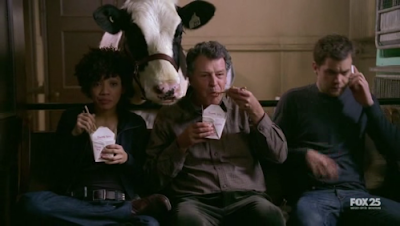

Also got hooked hard on Fringe, which seems to have a more protracted, defined arc than Abrams' Lost, which I could never get into. I hope this is the case; if things start to seem more in a general 'mysterious stuff that's never resolved' vibe it'll lose a lot of its value. Not sure I'd have gotten into the show if not for John Noble (Denethor) who is pretty much show stealing/defining as the disturbed genius Walter Bishop. Plot has some uncanny parallels with Half-Life, but it's probably just coincidence. The cases are frequently preposterous, which seems somewhat at odds with the vision of the show (or my perception of it) which seeks to try and rationalise or credibilise them. Also, one of the recurring characters is a cow.

Sunday, 29 August 2010
Shutter Your Face

I saw Shutter Island at last on Thursday night, through a funk of sickness. It is a good movie - good, but not great. Where it succeeds is in its visuals, texture, and performances. I have not seen Scorsese and DiCaprio's other projects, but on the basis of this they seem like a strong pair, and I'm now inclined to check out both Gangs of New York and the Departed.
DiCaprio makes the film, and, I think it is fair to say, in places he carries it. It's been a good year for him, and though Island is nothing like as good a film as Inception, DiCaprio's performance is actually better. Nolan's film did not offer him the time to decompress the character as he does here. Indeed, to an extent Teddy's character may be the point of the film.
It's odd the DiCaprio would choose to make this movie back to back with Inception, so similar are the roles. I am given to assume that he has a particular penchant for these characters who are in some way disconnected from reality, as was also a facet of Abagnale and Hughes. To be sure, he's good at playing them.
Ben Kingsley is also superb as the doctor who does not judge his criminally insane patients, and whose caring is shown through a very firm hand. At times he has to be the villain, at times to suggest a sinister edge, but at other times he needs to show a genuine caring. A tricky line, but one he walks well.
Mark Ruffalo adds the final element as DiCaprio's partner, Chuck. It's the sort of performance that will probably be overlooked, as it never steals any scenes from the other two, but it's a strong and credible showing which provides a solid third column for the piece.
It's the plot that prevents greatness being achieved. I can imagine that in novel form it may have been a stronger affair, but as presented on the screen, it's flawed. For one thing, the film is immensely predictable. Within the first five minutes, most of the audience will know exactly where the next two hours are going. Yet it maintains a sort of half-hearted pretense of playing with the audience, and at the end of the time you wonder whether you were ever meant to be decieved. The red herring plot threads - clearly evident as such even as they play out - seem to lack a point. In fact, events are so predictable, that I wonder if this was actually Scorsese's destination, or whether his actual goal was not the 'reveal', but that final line shared between Teddy and Chuck. Without that scene, the film would feel rather empty, but with it, it retroactively reinvests the film with some meaning, and a rewatch, treating the film as a study of Teddy, with the outcome in mind, and focussing on the way in which he interacts with and judges the other patients, may disclose some of the obfusticated point of the earlier scenes. If nothing else, it is in that final scene that the performances hit their highest notes.
So, anyway, like I said, good, but not great. Worth seeing once, at least, and maybe twice, particularly for the feel of the thing and for DiCaprio. 8/10
Also watched Magnolia, which I have had kicking about the place on DVD for years now. It's hard to find a time when I feel like sparing 3.5 hours, you know? Anyway, having settled to watch it the other night, lights off in the settling twilight, I was initially enjoying it a great deal. It certainly has a brilliant opening. Paul Thomas Anderson claims to have structured the film after the Beatles' track A Day in the Life, with its swelling peaks and crescendos which build, then ebb, then build again. I can certainly see the similarity. My problem with it is that it feels like one swell too man. It's being asked to emotionally invest one too many times, so by the end I felt a little bit of apathy. Certainly for the first 1:45 of its running time it keeps things pacy, lively, and changed up enough to be exhilirating. I quote '1:45' because that's the point when the film reached its midpoint crescendo and I was enjoying it so much I checked to make sure it wasn't going to be ending soon. Well, it wasn't, but shortly after this point it descends into its deepest trough - not in terms of quality, but in terms of emotion - and it doesn't quite sustain enough flourishes of pace and style to maintain the entertainment level as it coasts through. It's a pretty bleak film, and it gets a bit bogged down on the way into that final act.
In many respects it's akin to Benjamin Button, being long and sweeping in grandeur, and attempting a meditation on life through a considerable fixation on death, as well as love. But where that film was mawkish and tawdry, Magnolia succeeds, perhaps because it is inherently more vibrant to follow a tapestry of characters for a day than to follow one for a lifetime. But also generally, Magnolia simply creates more compelling, sympathetic characters than Button with its overly idiosyncratic weirdos. In particular Tom Cruise actually bothers to do some acting as a sort of heightened version of himself, and Julianne Moore provides the strongest showing as a messed up woman breaking down as her husband dies. There really isn't a weak link in the cast, though, and it'd be ephemeral of me to name everyone in turn. I'll give one final named credit to Philip Seymour Hoffman, though, who is excellent, like he generally is (also, I recommed seeing Capote).
All that, and it has Supertramp on the soundtrack, so you know it can't be bad (Although at present I have Aimee Mann's opening rendition of One is the Loneliest Number stuck in my head). 8/10, again.
Sunday, 22 August 2010
Saturday, 21 August 2010


Wednesday, 18 August 2010
Snatching the Pebble
 This is a fantastic book. It touches on an area I'm specifically fond of - gaming - but actually its appeal is far broader than that. Suits sums it up in his opening, when he says:
"It is the attempt to discover and formulate a definition, and to follow the implications of that discovery even when they lead in surprising, and sometimes disconcerting, directions."-p21
This was the aspect that really fuelled my interest unexpectedly, the definitional side of the argument, dressed often as a refutation of Wittgenstein. I might now have to follow up on this, but I wonder if I'll find other books on the subject that are even half as entertaining a read as this one.
That's the great strength of the book. It's as enjoyable as the best fiction, really, laugh-out-loud funny in places, and even dramatic and characterful at times. Suits chooses to address his points in the form of a socratic dialogue between anthropomorphic insects drawn from Aesop's fable. The inherent humour of the idea is obviously just one joke, and would fast become tired, but Suits infuses the ongoing discourse with so many amusing twists and turns and flourishes, and his mouthpieces become characters in their own right. The triumphant return of the Grasshopper in the final chapters is, absurdly, genuinely thrilling.
And as if that wasn't enough, the conclusion reached in those chapters is really jaw droppingly intriguing. It's stated right at the beginning, but in a deliberately riddled form which gives the meat of the book its pretext for unpicking the meaning of 'games'. When things finally come full circle, the moment of comprehension makes the price of entry worthwhile alone.
If only there were more philosophical texts like this. Fantastic, 10/10 stuff.
(I found an abridged exceprt of one of the best chapters online. Check it out, then buy the book!
http://www.senia.com/2006/11/21/ivan-and-abdul-by-bernard-suits-part-i/
http://www.senia.com/2006/11/22/ivan-and-abdul-by-bernard-suits-part-ii/ )
Now reading The Book of Unholy Mischief. Only a scant few pages in, but I don't expect much from it. Seems to suffer badly by being an almost identical tale to Locke Lamora, but without the gift for plot, characters or prose possessed by Lynch.
And on that note, sometime soon I really want to get dug into The Republic of Thieves. The Lamora series has been pretty fun so far, and it quietly promises to become something rather notable.
Similarly, I find myself more eager to pick up A Clash of Kings than I expected to be. Though I found a few elements offputting when I read Game, the strengths of the good characters have lingered in my mind beyond the flaws of the weak ones. So I'll probably get on with that at some point.
 And in digital news, I got snared again in Desktop Dungeons tonight. What an amazing game. It's got the most finely tuned balance of depth, elegance, ease of learning, challenge and everything else that I've found in a game. It also succeeds admirably in conjuring up the feel of the best parts of roguelikes without any of the barriers to entry. The new update has tarted things up a bit too, and I'm liking the change to dieties. No sooner had I mentioned it to a friend than I had to dive back in and I didn't stop until I'd ran a monk and a paladin through Normal mode. Now I've got designs on a Gnome Warlord for the next. I only hope the guy behind this doesn't leave it a one off.
What else? I'm sure there was something. Oh yes, a project has finally got legs. I may have a new boardgame prototyped by the weekend.
Fun times.
Bonus Credit Question:
If you could replace your body with a synthetic body which would look and feel indistinguishable from a real body, and would never fall prey to illness, would you do it?
That's the great strength of the book. It's as enjoyable as the best fiction, really, laugh-out-loud funny in places, and even dramatic and characterful at times. Suits chooses to address his points in the form of a socratic dialogue between anthropomorphic insects drawn from Aesop's fable. The inherent humour of the idea is obviously just one joke, and would fast become tired, but Suits infuses the ongoing discourse with so many amusing twists and turns and flourishes, and his mouthpieces become characters in their own right. The triumphant return of the Grasshopper in the final chapters is, absurdly, genuinely thrilling.
And as if that wasn't enough, the conclusion reached in those chapters is really jaw droppingly intriguing. It's stated right at the beginning, but in a deliberately riddled form which gives the meat of the book its pretext for unpicking the meaning of 'games'. When things finally come full circle, the moment of comprehension makes the price of entry worthwhile alone.
If only there were more philosophical texts like this. Fantastic, 10/10 stuff.
(I found an abridged exceprt of one of the best chapters online. Check it out, then buy the book!
http://www.senia.com/2006/11/21/ivan-and-abdul-by-bernard-suits-part-i/
http://www.senia.com/2006/11/22/ivan-and-abdul-by-bernard-suits-part-ii/ )
Now reading The Book of Unholy Mischief. Only a scant few pages in, but I don't expect much from it. Seems to suffer badly by being an almost identical tale to Locke Lamora, but without the gift for plot, characters or prose possessed by Lynch.
And on that note, sometime soon I really want to get dug into The Republic of Thieves. The Lamora series has been pretty fun so far, and it quietly promises to become something rather notable.
Similarly, I find myself more eager to pick up A Clash of Kings than I expected to be. Though I found a few elements offputting when I read Game, the strengths of the good characters have lingered in my mind beyond the flaws of the weak ones. So I'll probably get on with that at some point.
 And in digital news, I got snared again in Desktop Dungeons tonight. What an amazing game. It's got the most finely tuned balance of depth, elegance, ease of learning, challenge and everything else that I've found in a game. It also succeeds admirably in conjuring up the feel of the best parts of roguelikes without any of the barriers to entry. The new update has tarted things up a bit too, and I'm liking the change to dieties. No sooner had I mentioned it to a friend than I had to dive back in and I didn't stop until I'd ran a monk and a paladin through Normal mode. Now I've got designs on a Gnome Warlord for the next. I only hope the guy behind this doesn't leave it a one off.
What else? I'm sure there was something. Oh yes, a project has finally got legs. I may have a new boardgame prototyped by the weekend.
Fun times.
Bonus Credit Question:
If you could replace your body with a synthetic body which would look and feel indistinguishable from a real body, and would never fall prey to illness, would you do it?
Tuesday, 10 August 2010
And We'll All Be Lonely Tonight, And Lonely Tomorrow
There's a scene at the top of the first episode of Moffat and Gatiss' new 'Sherlock' in which invalided Watson discusses his blog with the therapist who encouraged him to start one.
'You need to learn how to be a civillian again; keeping a record of everything that happens to you will help,' she tells him. He glances up and gives her an empty smile.
'Nothing happens to me,' he says.
I think this is my problem too. I find it incredibly hard to write anything, compared to everyone else I know. And what I do write is pretty impersonal in contrast with others, too. But then, every one of my days is exactly the same as the last: I wake up at a stupid time, sit in front of a computer, eat some crap food, and go back to bed. So what's to write?

Anyway, another year another Holmes. So what's this one like? Well, it's an improvement over last Christmas' Downey Jr attempt which, whilst entertaining and well directed, was using the Holmes name as little more than a marketing tool. Should have been the start of a new and potentially promising IP, but no dice. Moderate spoilers follow.
This adaptation is Holmes, anyway. It's not pure Holmes - it is, after all, modern day set - but it's Holmes at the heart. So that's good. I'm glad we're not being saturated by empty-but-bankable names. I wasn't really concerned for this respect, though. Moffat and Gatiss have more artistic integrity than that.
The modernisation was a concern, but is actually pretty good. Holmes' technophilia is fitting and interesting. We see how Holmes changes to fit into the new world of forensics and connectivity. This is ultimately what I feared would be missed, but it wasn't. Good!
I run hot and cold on Cumberbatch (he keeps asking me not to). At times he is very good, and very holmely (Sorry). At other times he doesn't quite work for me. He's a bit younger than I expected them to cast, but this seems to be Moffat's way at the moment, and it's working out alright. Cumberbatch does add a slightly disaffected modern-batcherlor-with-cash arrogant layabout undercurrent to the character. It's good and interesting, another nice manifestation of the modern translation, although occaisionally it spills over too far.
I have more trouble with Martin Freeman's Watson. Is this surprising? Nobody seems to be able to get Watson right. At the least, he is not so far gone as to be a New-Watson-Likes-Jam, but he's a bit dull. He's not dim, mostly, but he is the butt of the jokes sometimes, and whilst he retains the moral compass aspect, it surfaces less often and in milder ways. The flaring arguments of the pair are absent. Freeman plays him fine, in fact he's rather good - particularly in Episode 3 where he solves the Bruce Partington Plans mystery for Mycroft. It's just that I don't think he's written particularly interestingly. He's like Watson with the saturation turned down.
The real issue, might fall between them. Discussing with DJS the point came up that this Holmes has no real pain. So he's really not a sociopath - his behaviour is just 'a bit of a dick' (said with a sideways smile). And because he has no real pain, there is no real source of trouble and concern for Watson, and no conflict between them. And this weakens both.
Meanwhile, everybody hates Moriarty. My own reaction was actually less harsh than most, but I think that was largely because I had been braced for him to suck bollocks from the beginning. He's a charicature, and not remotely Moriarty. That said, the core of the character is not terrible of itself, and would have worked as an original villain, except that the panto performance added to it goes far too far over the top. The problem with portrayals of Moriarty, I think, is that he gets about three lines of dialogue in the entirety of the original source material. The Final Problem is so utterly terrifying because Moriarty is all but invisible, a wraith and an assassin, pursuing Holmes but barely glimpsed.
An unexpected highlight for me was Gatiss' Mycroft. Notsomuch in Episode 1, where he's a bit too much of a comic device, but in Episode 3, where he is actually a character in his own right. I fell for the (somewhat contrived) Moriarty misdirection, and I'm glad he wasn't. But then, he would actually have been better than what we got. (It seems obvious to me that it'll be Mycroft who pulls them out of the fire in the cliffhanger resolution.)
Three episodes isn't much, and I still haven't made a settled opinion on the series. Part of the problem is all three scripts have had their flaws, which makes judging the tone and direction harder. But there's enough there to make some fairly solid judgments.
The modern, high-tech aspect is a winner. It's used judiciously, and captures the cerebral mind-workings of Holmes. The floating phone text device is a good one, as long as they keep using it with restraint. And visually it all looks pretty good. The golem scene is a bit bizarre, sort of tripping into expressionism. Quite nice on its own, utterly unlike the rest. Interesting to imagine what the show might be like if it goes further that way.
But the real problem, the generalised issue that really stems into all of the others, is that the tone of the thing is too whimsical. Just like all the modern Holmes stuff. It takes the idiosyncracies of the character and the cases and plays them lighthearted. Now, this worked well in the sly references to canon (The five pips was inspired), but in terms of the actual vibe of the show it was too light. If I ever adapted Holmes it would be a dark, dark thing. Not humourless: There is plenty of humour in Holmes. But dark. This man is, really, a very unhealthy character, whilst Watson is disaffected and has issues of his own. And many of the crimes they handle are borne out of severe depravity and moral bankruptcy. Holmes should be dark.
For me, the radio adaptation remains head-and-shoulders the best. Merrison and Williams ARE Holmes and Watson. I think it's as good as a straight adaptation could be. So for my money, the real merit in any new adaptation is going to be putting another angle on things, finding something different. 'Sherlock' had the potential to do that, and it still does. I really hope it goes for it.
(Ratings, because I love rating stuff:
A Study in Pink - 8/10
The Blind Banker - 7/10
The Great Game - 8/10, by a whisker.)
'You need to learn how to be a civillian again; keeping a record of everything that happens to you will help,' she tells him. He glances up and gives her an empty smile.
'Nothing happens to me,' he says.
I think this is my problem too. I find it incredibly hard to write anything, compared to everyone else I know. And what I do write is pretty impersonal in contrast with others, too. But then, every one of my days is exactly the same as the last: I wake up at a stupid time, sit in front of a computer, eat some crap food, and go back to bed. So what's to write?

Anyway, another year another Holmes. So what's this one like? Well, it's an improvement over last Christmas' Downey Jr attempt which, whilst entertaining and well directed, was using the Holmes name as little more than a marketing tool. Should have been the start of a new and potentially promising IP, but no dice. Moderate spoilers follow.
This adaptation is Holmes, anyway. It's not pure Holmes - it is, after all, modern day set - but it's Holmes at the heart. So that's good. I'm glad we're not being saturated by empty-but-bankable names. I wasn't really concerned for this respect, though. Moffat and Gatiss have more artistic integrity than that.
The modernisation was a concern, but is actually pretty good. Holmes' technophilia is fitting and interesting. We see how Holmes changes to fit into the new world of forensics and connectivity. This is ultimately what I feared would be missed, but it wasn't. Good!
I run hot and cold on Cumberbatch (he keeps asking me not to). At times he is very good, and very holmely (Sorry). At other times he doesn't quite work for me. He's a bit younger than I expected them to cast, but this seems to be Moffat's way at the moment, and it's working out alright. Cumberbatch does add a slightly disaffected modern-batcherlor-with-cash arrogant layabout undercurrent to the character. It's good and interesting, another nice manifestation of the modern translation, although occaisionally it spills over too far.
I have more trouble with Martin Freeman's Watson. Is this surprising? Nobody seems to be able to get Watson right. At the least, he is not so far gone as to be a New-Watson-Likes-Jam, but he's a bit dull. He's not dim, mostly, but he is the butt of the jokes sometimes, and whilst he retains the moral compass aspect, it surfaces less often and in milder ways. The flaring arguments of the pair are absent. Freeman plays him fine, in fact he's rather good - particularly in Episode 3 where he solves the Bruce Partington Plans mystery for Mycroft. It's just that I don't think he's written particularly interestingly. He's like Watson with the saturation turned down.
The real issue, might fall between them. Discussing with DJS the point came up that this Holmes has no real pain. So he's really not a sociopath - his behaviour is just 'a bit of a dick' (said with a sideways smile). And because he has no real pain, there is no real source of trouble and concern for Watson, and no conflict between them. And this weakens both.
Meanwhile, everybody hates Moriarty. My own reaction was actually less harsh than most, but I think that was largely because I had been braced for him to suck bollocks from the beginning. He's a charicature, and not remotely Moriarty. That said, the core of the character is not terrible of itself, and would have worked as an original villain, except that the panto performance added to it goes far too far over the top. The problem with portrayals of Moriarty, I think, is that he gets about three lines of dialogue in the entirety of the original source material. The Final Problem is so utterly terrifying because Moriarty is all but invisible, a wraith and an assassin, pursuing Holmes but barely glimpsed.
An unexpected highlight for me was Gatiss' Mycroft. Notsomuch in Episode 1, where he's a bit too much of a comic device, but in Episode 3, where he is actually a character in his own right. I fell for the (somewhat contrived) Moriarty misdirection, and I'm glad he wasn't. But then, he would actually have been better than what we got. (It seems obvious to me that it'll be Mycroft who pulls them out of the fire in the cliffhanger resolution.)
Three episodes isn't much, and I still haven't made a settled opinion on the series. Part of the problem is all three scripts have had their flaws, which makes judging the tone and direction harder. But there's enough there to make some fairly solid judgments.
The modern, high-tech aspect is a winner. It's used judiciously, and captures the cerebral mind-workings of Holmes. The floating phone text device is a good one, as long as they keep using it with restraint. And visually it all looks pretty good. The golem scene is a bit bizarre, sort of tripping into expressionism. Quite nice on its own, utterly unlike the rest. Interesting to imagine what the show might be like if it goes further that way.
But the real problem, the generalised issue that really stems into all of the others, is that the tone of the thing is too whimsical. Just like all the modern Holmes stuff. It takes the idiosyncracies of the character and the cases and plays them lighthearted. Now, this worked well in the sly references to canon (The five pips was inspired), but in terms of the actual vibe of the show it was too light. If I ever adapted Holmes it would be a dark, dark thing. Not humourless: There is plenty of humour in Holmes. But dark. This man is, really, a very unhealthy character, whilst Watson is disaffected and has issues of his own. And many of the crimes they handle are borne out of severe depravity and moral bankruptcy. Holmes should be dark.
For me, the radio adaptation remains head-and-shoulders the best. Merrison and Williams ARE Holmes and Watson. I think it's as good as a straight adaptation could be. So for my money, the real merit in any new adaptation is going to be putting another angle on things, finding something different. 'Sherlock' had the potential to do that, and it still does. I really hope it goes for it.
(Ratings, because I love rating stuff:
A Study in Pink - 8/10
The Blind Banker - 7/10
The Great Game - 8/10, by a whisker.)
Saturday, 7 August 2010
But Can You Put Your Hands in Your Head?

So, I saw Inception on Wednesday (but there's no spoilers here). So heavily hyped has it been, I was actually quite prepared for a disappointment. Pleasantly surprising, then, to find that it was a film that deserved hype - albeit perhaps notw quite the absurd amount it has recieved.
I suppose it is this decade's Matrix, although less showy and more thoughtful than that film. It has the same high-concept/action thriller blending. It is, perhaps, too busy. I can seperate out two distinct plot threads that could have been decompressed into more elegant movies each. In fact, far more than that earlier series, here is an idea that meritted a trilogy format. Alas, this is not really Nolan's style. But even lacking that, and with the frustrating corollary that some ideas are not taken as far as one would like, it's a damned good film.
There's plenty of discussion- and thinking-fodder on offer there, but that's what everyone is talking and it doesn't need me to chime in (although I do have a personal pet theory, which I may record later). What I wanted specifically to make mention of was the visuals.
There are some jaw-dropping VFX and action sequences in the film. They're inspired both in terms of the ideas on the screen, and the thinking that has gone into their execution (I am sure some of what I saw must have been wire work, but if so it was the best damned wire work I have ever seen). And aside from this, the whole film looks superb. But here's what I really appreciate: None of it was gratuitous, for its own sake. All the action and effects were born of the concepts, and reinforced them and the story. That's really good, that's what completed the package.
It's cinematic in its truest sense - this is what cinema should be. And it may have swayed me in favour of 3D. I saw this on a pretty small screen, but wow, I would have loved to see that on an iMax in 3D.
Strongly recommended, a 9/10. (Narrowly pipped by Memento as my favourite of Nolan's films, though.)
Subscribe to:
Posts (Atom)